Mathematical Language
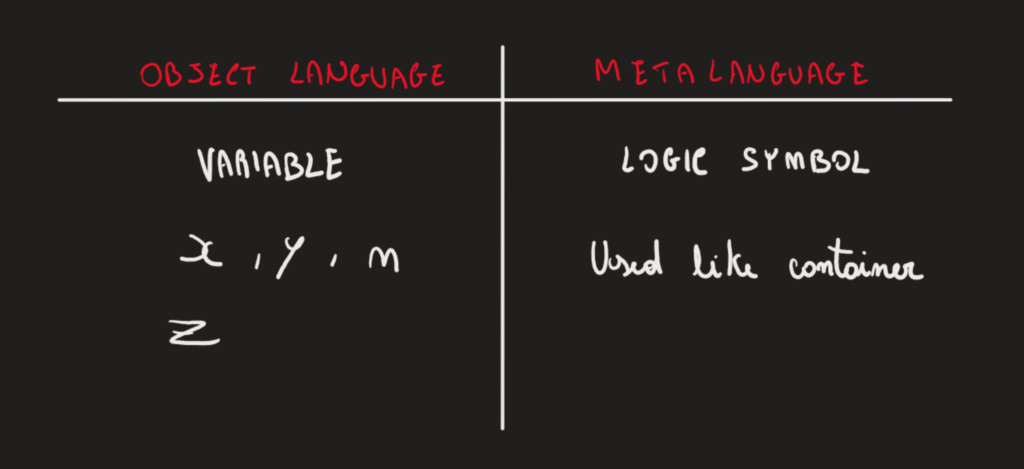
When approaching a new subject, we realize that we come into contact with terms related to it. In order to express concepts, symbols have been created to represent ideas precisely. More specifically, mathematical language consists of two types of languages: the object language and the meta-language.
More commonly, the object language represents the symbols, while the meta-language expresses and explains them.
Property and Proposition
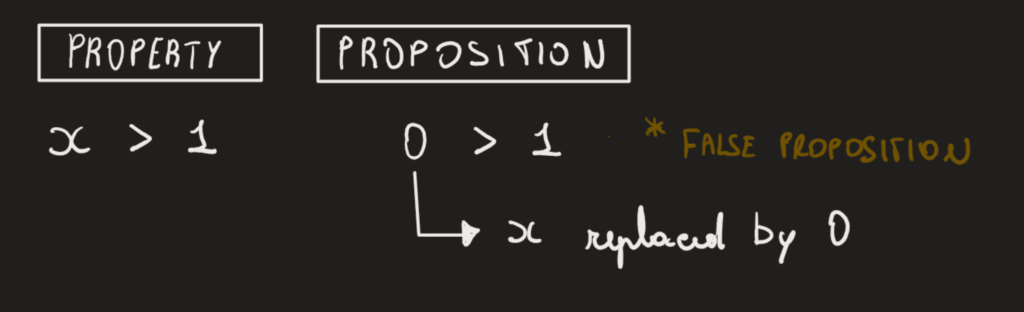
An expression like x > 1 is a property, which can also become a proposition under specific conditions.
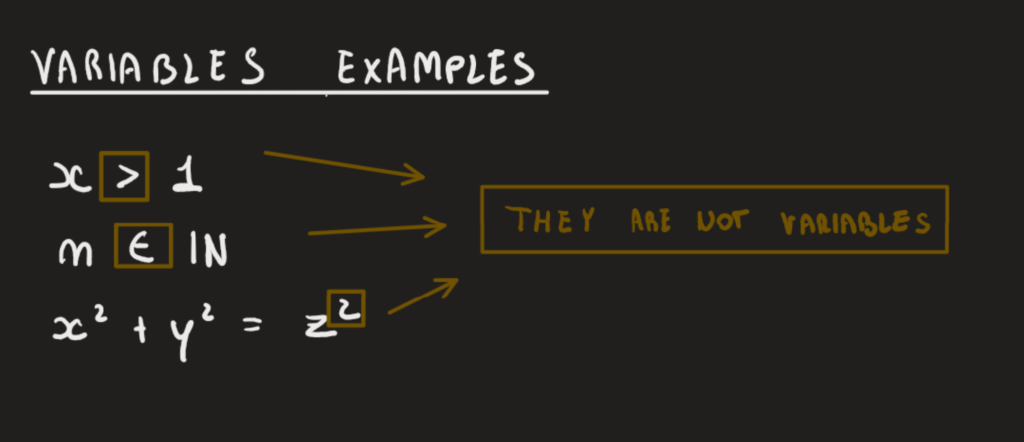
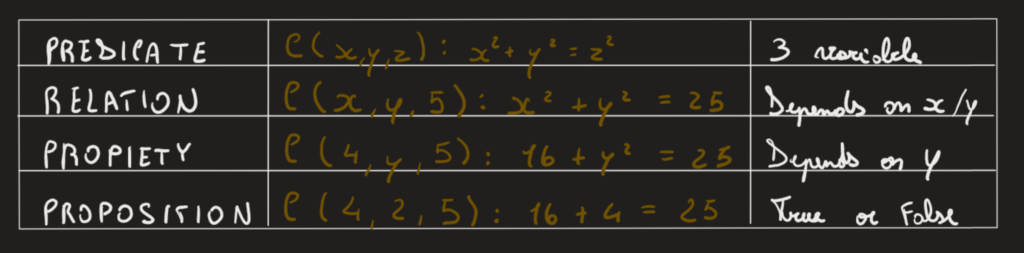
A property is said to become a proposition when a specific value is assigned to x. By substituting a value in place of the variable, we obtain a concrete proposition that can be evaluated as true or false.
Property, Relation, Predicates
Let us clarify these concepts, as mathematics involves many terms that can often be confusing:
- Property: Expressions that depend on a single variable, such as
P(x), which representsx ≥ 2. - Relations: Properties involving more than one variable, such as
P(x, y), which representsx + 5 = 5y. - Predicates: Functions that return a Boolean value (
TRUEorFALSE).
The exact same formula can take on these three different forms depending on its mathematical context.
Quantifiers
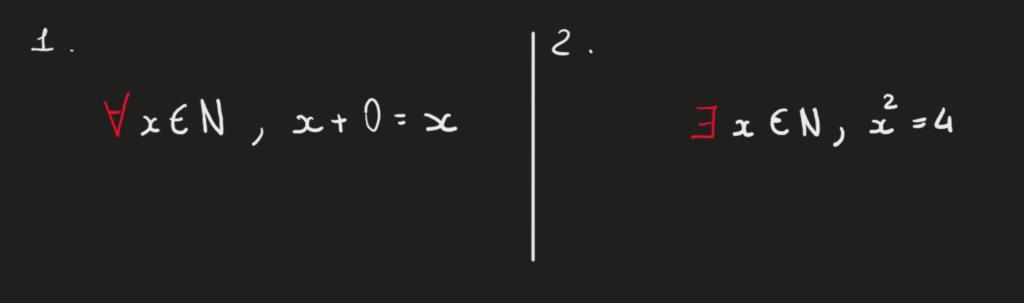
In logic, quantifiers are used to express statements that involve all or some elements of a given set. The two main quantifiers are:
- The universal quantifier (
∀), which means "for every" or "for all". - The existential quantifier (
&exists;), which means "there exists at least one".
Negation of Quantifiers
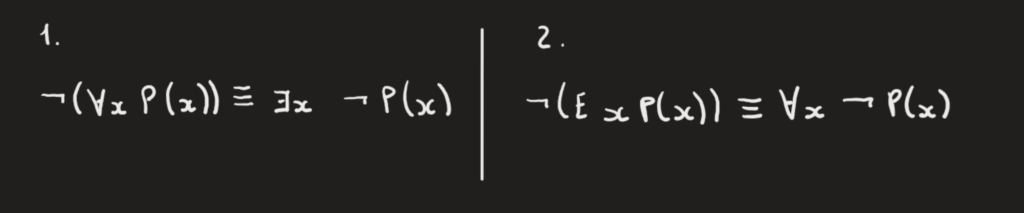
An important aspect of quantifiers is how we can manipulate them using logical negations:
- The negation of a universal quantifier (
∀) becomes an existential quantifier (&exists;). - The negation of an existential quantifier (
&exists;) becomes a universal quantifier (∀).
Equality Relation
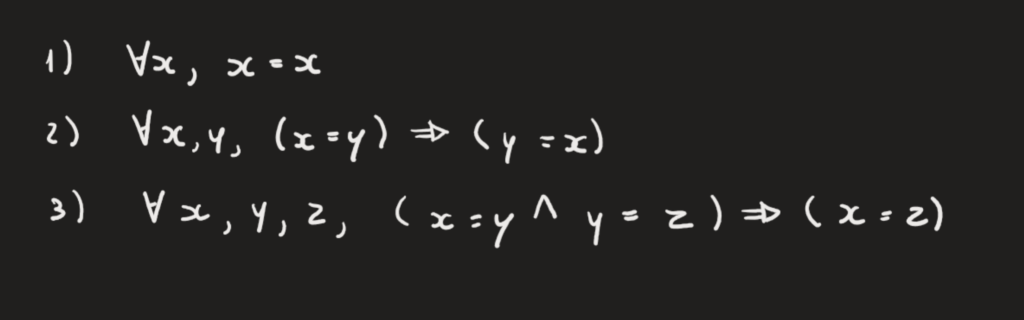
The equality relation is a binary relation that indicates when two elements are considered identical. Equality is a fundamental equivalence relation that must satisfy three core properties:
- Reflexivity: Every element is equal to itself (
x = x). - Symmetry: If
x = y, theny = x. - Transitivity: If
x = yandy = z, thenx = z.